Cancer cells use microscopic tunnels to spread a pre-cancerous state to healthy breast cells
Before a cancer fully forms, cells go through a preneoplastic phase — a kind of 'almost cancer' state. A new study reveals that tunneling nanotubes (TNTs), thin actin-rich tubes that cells use to communicate over long distances, play a surprising role in this early transformation of breast tissue.

Cancer cells use microscopic tunnels to spread a pre-cancerous state to healthy breast cells
Before a cancer fully forms, cells go through a preneoplastic phase — a kind of 'almost cancer' state. A new study reveals that tunneling nanotubes (TNTs), thin actin-rich tubes that cells use to communicate over long distances, play a surprising role in this early transformation of breast tissue.
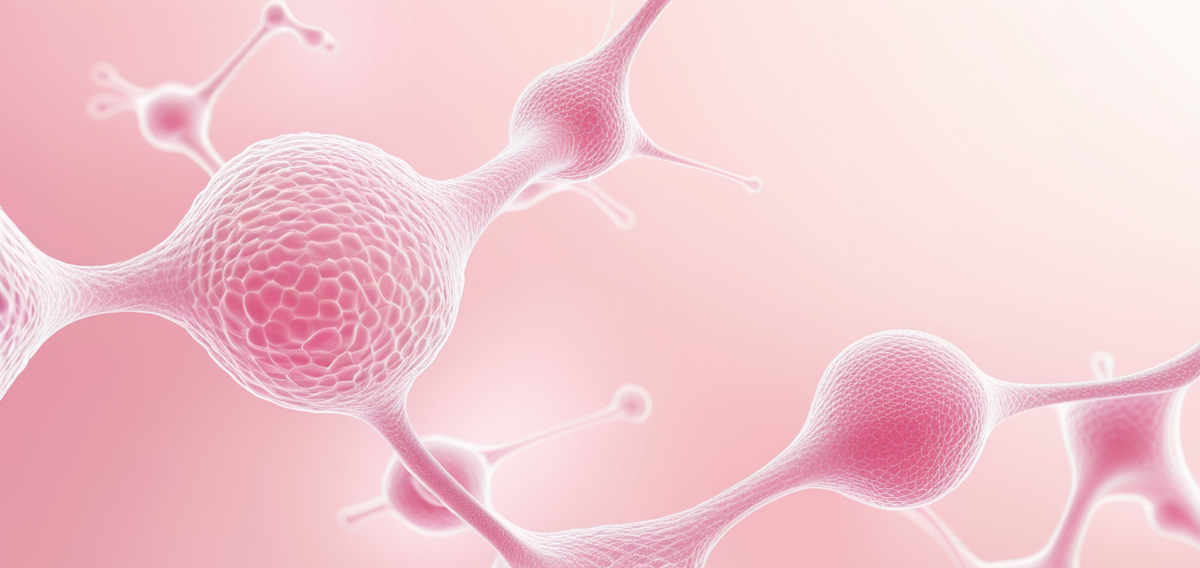
Researchers found that during early luminal breast cell transformation, TNTs become more abundant and elongated. Crucially, these tubes preferentially connect already-transformed cells to normal ones — essentially creating a directional communication network from diseased to healthy cells. Proteomic and microscopy analyses revealed that this connection transmits BMP (bone morphogenetic protein) signaling, propagating a preneoplastic state to recipient cells.
This is notable because it reframes how early cancer initiation might work: not just as isolated mutations in individual cells, but as a spreading, contagious-like process where transformed cells actively recruit neighboring normal cells into a pre-cancerous state via physical nanotube connections.
Key Findings
- Tunneling nanotubes (TNTs) become more abundant during early luminal breast transformation
- TNTs preferentially connect transformed donor cells to non-transformed acceptor cells
- BMP-dependent signaling is transmitted through TNTs to propagate a preneoplastic state
- TNT-mediated communication may drive cancer field effects in early breast carcinogenesis
- Super-resolution microscopy confirmed the directional nature of these nanotube connections
Implications
This research opens a new perspective on cancer initiation — specifically, that early tumor formation may involve cooperative field effects spread through nanotube networks, not just isolated mutant cells. Targeting TNT formation or BMP signaling in pre-malignant tissue could be a novel strategy to prevent breast cancer development.
Caveats
This is a preprint without peer review. Study uses primary human mammary cells and organoid models, not human patients. The complexity of nanotube biology in living tissue means in vivo validation will be essential. Summary based on abstract only.
Source: bioRxiv — 2026-04-11